
For a wedding morning or a shared getting-ready session, plan real service durations and separate artists around a fixed ready time. The beauty appointment timeline: work back from ready shows its method and lets you keep the calculation.
The morning version
Sunscreen, a light base, a brow, a lip and a mascara take less time than most people think. The base should be one you can reapply by hand in the car park, which rules out heavy cream foundation for most jobs. A cream blush placed high on the cheek brightens the face without looking like makeup.
The travel kit
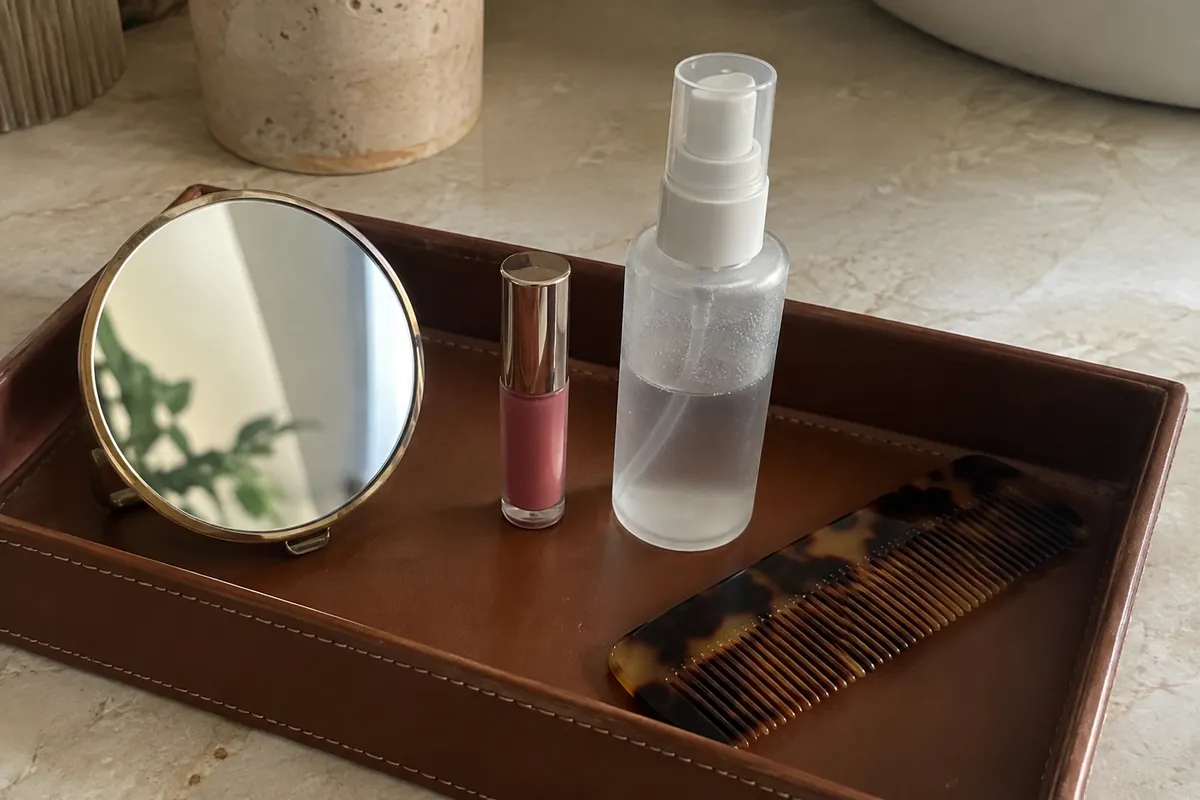
Keep a kit that fits in one pouch: a blotting sheet, a lip tint, a mini setting spray, a brow pencil, a small comb and a tinted balm. Replace anything that dries out or smells off. A kit you actually use beats a larger one that stays in the bag.
Midday and evening
Blot gently if that is comfortable, and refresh only what you want to wear. Use a setting spray according to its label; it is not a way to cool or hydrate irritated skin.
Remove makeup gently at the end of the day. For outdoor exposure, plan sun protection and reapplication rather than expecting the morning makeup to do every job.
Separate the used tools in a workday kit
Pack the clean, dry tools needed for the touch-ups you actually make, rather than the whole bathroom cup. Carry them so the tips are protected and not pressed into loose powder or a leaking product. Keep used brushes separate until you can clean them at home.
Do not seal a damp brush into a makeup pouch to finish drying during the commute. Plan the brush wash after the last application and check complete dryness before packing. If that does not fit the morning schedule, choose a suitable clean alternative or reduce the number of tools you use.
At the end of the week, empty the pouch and check its condition before returning the clean kit. A short maintenance check is more useful than buying a larger bag for items you never reach for.
Does a leaking product mean you need a larger work kit?
Resolve the leaking package before buying another pouch or adding backup products. A bigger kit can hide the same problem in another pocket. Empty the affected section, identify the container and keep it out until you have dealt with the leak and checked its condition.
| Task | What it answers |
|---|---|
| Check the container | Can it close and be stored as directed? |
| Check the pouch | Which care method does its maker permit? |
| Review the contents | Which familiar items will you actually use today? |
Use the pouch care decision guide for the second task. Long work hours alone do not justify carrying extra products; a smaller, intact kit may be easier to review. Neither a tidy pouch nor a fresh-looking package certifies the cosmetic inside.
Keep the work kit small without losing its identity
A short workday routine still needs products whose identity and instructions are clear. Before relying on a travel item, keep its name and variant with any necessary label information. A smaller container is not useful if you can no longer tell what is inside it or which directions apply.
| Record | Keep separate |
|---|---|
| Ready for the kit | Identified item with the applicable instructions |
| Awaiting clarification | Missing marking or label question recorded separately |
| Planning alternative | A familiar identified item, when one is needed |
Keep a product awaiting clarification apart from the ready kit rather than counting it as an available step. Ask the brand about the actual marking and package; a retail scan alone is not an answer to every shelf-life question. This keeps the routine practical without buying a replacement for a question you have not yet identified. Use the batch-code and barcode comparison for the different marks and next questions.
How do you plan a small kit when a dispenser is unresolved?
A product you own is not automatically an available step in the morning routine. If its dispenser has stopped working, keep that status separate from a confirmed empty container or an item you have chosen to replace. The practical goal is a usable kit, not completing a theoretical list.
| Keep separate | Information |
|---|---|
| Ready item | Identified product with a functioning intended container |
| Unresolved item | Symptom and official support question recorded |
| Alternative plan | A familiar suitable item, or leaving an optional step out |
Do not decant an unidentified or damaged product simply to keep the planned routine unchanged. Ask the brand which instructions apply and retain the result of any permitted start-up step. Until the issue is clarified, use an already workable routine rather than assigning a promised recovery time to the pump. Keep an optional cosmetic step optional; a smaller kit is easier to use when its actual contents and availability are clear. The airless-pump observation and support guide organizes the product-specific questions.
Build the kit that fits your day
Questions people ask
Is it worth wearing foundation to work?
Many people do better with a tinted moisturiser or skin tint that they can reapply quickly and that looks more natural by afternoon.
How do I stop my mascara smudging by lunch?
Choose a smudge-resistant formula and let it dry fully before blush. Keep a clean spoolie in the pouch to comb out clumps.
Sources and further reading
Sources checked 2026-10-25.